Our research on quasi-normal modes, the ringing of black holes and wormholes, told in plain words for every curious reader.
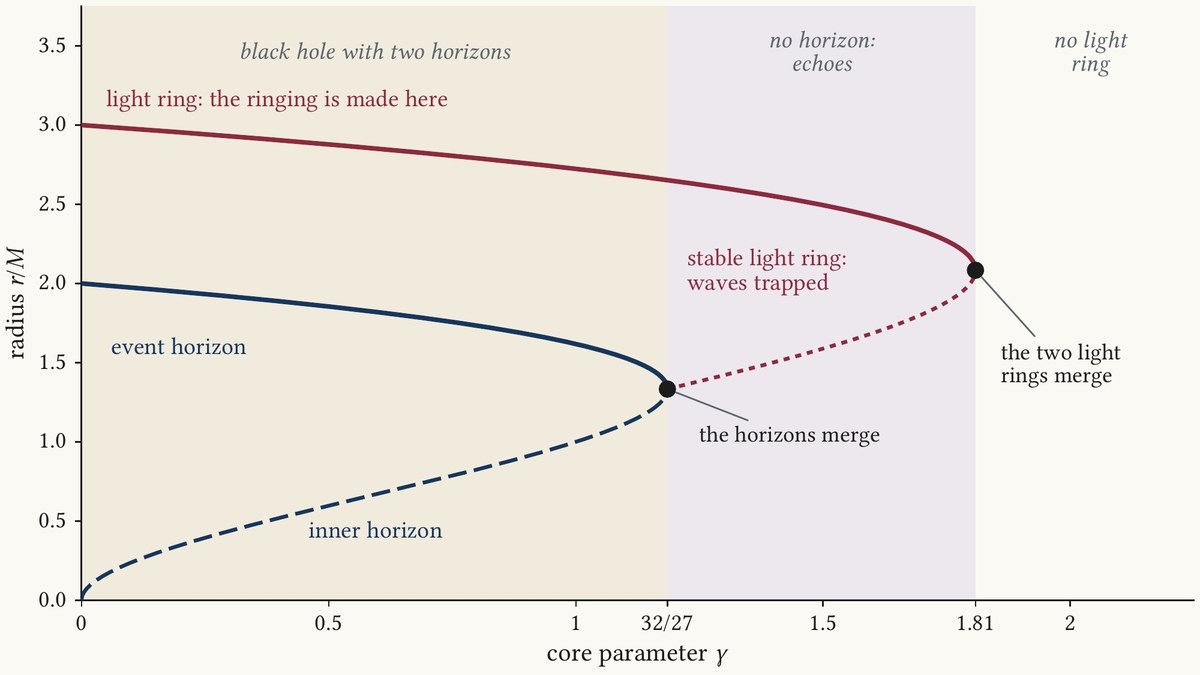
As the core grows, the horizons of a Hayward black hole draw together and merge, while the light ring, where the ringing is made, moves inward. Credit: Denys Dutykh and Davide Batic.
When two massive celestial objects collide, the newly formed black hole vibrates like a struck bell, shedding energy through gravitational ripples that gradually fade into space. In standard general relativity, these vibrations echo across a geometry that conceals an infinitely dense central singularity where physical laws fail. For decades, theorists have studied regular black holes, alternative models where quantum effects replace that singular point with a smooth, finite-density core. Changing the interior structure alters how mass curves the surrounding spacetime, subtly shifting the notes and decay rates of the gravitational radiation emitted during ringdown.
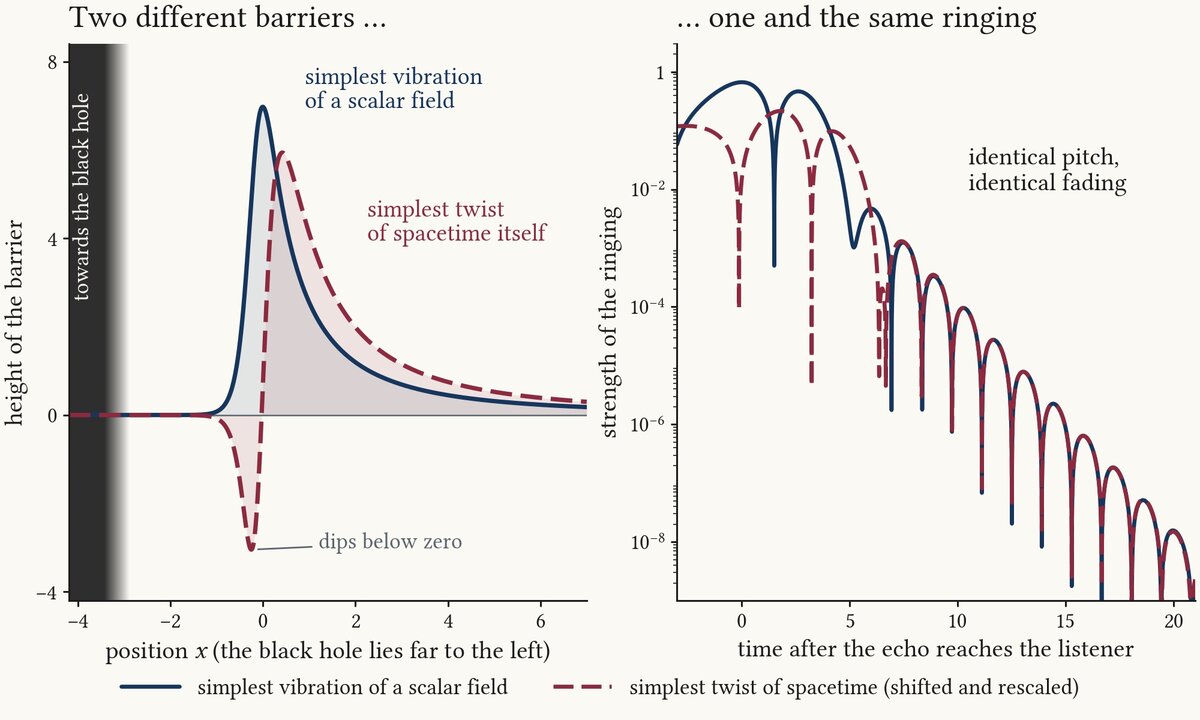
Two barriers around a ten-dimensional black hole that look nothing alike (left) trap waves that ring with the same pitch and the same fading (right). Credit: Denys Dutykh and Davide Batic, CC BY 4.0.
Strike a bell, and it rings with a pitch and a fading that tell you about the bell: its size, its shape, the metal it is made of. Black holes ring too. When two merge, the newborn black hole shivers and sheds gravitational waves in a brief, dying chord, and since 2015, gravitational-wave detectors have been listening. The notes of that chord, which physicists call quasinormal modes, depend only on the black hole's mass and spin and on the law of gravity itself. Change the law, and the chord changes.
Quasinormal modes of Hayward black holes from Schwarzschild to extremality: A comparative spectral analysis
Batic, D. & Dutykh, D.
Batic, D. & Dutykh, D. (2026). Quasinormal modes of Hayward black holes from Schwarzschild to extremality: A comparative spectral analysis. Phys. Dark Univ., 54, 102467.
Quasinormal-mode analysis of a massive scalar field in a Schwarzschild background via the spectral method
Batic, D., Chrysostomou, A., Cornell, A. S. & Dutykh, D.
Batic, D., Chrysostomou, A., Cornell, A. S. & Dutykh, D. (2026). Quasinormal-mode analysis of a massive scalar field in a Schwarzschild background via the spectral method. Phys. Rev. D, 114(6), 065020.
Quasinormal modes of Gauss–Bonnet black holes via the spectral method: Scalar, vector, and tensor perturbations
Batic, D. & Dutykh, D.
Batic, D. & Dutykh, D. (2026). Quasinormal modes of Gauss–Bonnet black holes via the spectral method: Scalar, vector, and tensor perturbations. Phys. Rev. D, 114(4), 044015.
Quasinormal modes of the Kazakov–Solodukhin quantum-corrected black hole: a spectral analysis
Batic, D., Dutykh, D. & Sukaiti, M. E.
Batic, D., Dutykh, D. & Sukaiti, M. E. (2026). Quasinormal modes of the Kazakov–Solodukhin quantum-corrected black hole: a spectral analysis. Eur. Phys. J. C, 86(7), 847.
Quasi-normal modes of non-commutative geometry-inspired dirty black holes
Batic, D., Dutykh, D. & Babou, Z. A.
Batic, D., Dutykh, D. & Babou, Z. A. (2025). Quasi-normal modes of non-commutative geometry-inspired dirty black holes. Proc. R. Soc. A, 481, 20250021.
A spectral approach for quasinormal frequencies of noncommutative geometry-inspired wormholes
Batic, D., Dutykh, D. & Jamal Beek, J.
Batic, D., Dutykh, D. & Jamal Beek, J. (2025). A spectral approach for quasinormal frequencies of noncommutative geometry-inspired wormholes. Class. Quantum Grav., 42(8), 085003.
Unified spectral approach for quasinormal modes of Lee-Wick black holes
Batic, D., Dutykh, D. & Giacchini, B. L.
Batic, D., Dutykh, D. & Giacchini, B. L. (2024). Unified spectral approach for quasinormal modes of Lee-Wick black holes. Phys. Rev. D, 110(8), 084032.